Roswell Educational Achievement Foundation
Technology for Educational Pilot School Project Report
Introduction
In 1994, the Roswell Educational Achievement Foundation sponsored a pilot "Technology for Education" elementary school using principles of the "Full Commitment Model" developed by the Foundation and embraced by the Roswell, New Mexico Independent School District (RISD).
After completing a full school year, test results show impressive improvement in achievement levels, particularly in the core area of reading and writing (indirect measurements of student/teacher success such as lowered disciplinary problems, absenteeism, tardiness and heightened levels of achievement by students not previously successful in the traditional classroom setting were noted by the middle of the first semester). Teachers at the Pilot School universally view their experience as positive and rewarding and see the technology, as applied in the Model, as a major improvement in helping them achieve success with different types of learners.
After viewing the success of the pilot school, the community passed a bond issue with sufficient funds to implement technology throughout the school district (including middle and high school levels as well as elementary) using the "Full Commitment Model".
The Roswell Educational Achievement Foundation
The Roswell Educational Achievement Foundation was established in 1992 by a group of business people committed to excellence in public schools. We believed public schools that achieved their educational mission were a critical asset to our community. We believed that public schools needed the human resources and experience base of the business community and that, by creating a third-party Foundation, we could help provide those resources without being constrained by the structural impediments of public education. We were convinced there were opportunities for public schools that could not be realized without the influence of a third party business oriented group at the local level.
In addition to assisting the Roswell School District with its Technology Project, the Foundation sponsors annual Laureate Awards which involve the recognition of top teachers in the community -- members of our "Laureate Circle" (Laureate Circle members are selected by a community-based selection committee chosen by the Foundation board). At a banquet held in honor of the Laureate Circle three of the most outstanding, inspirational teachers are recognized and given the "Laureate Award" which includes a cash grant of $5,000 given without condition.
Technology Project
Background
Members of the Foundation Board became aware of the school district's technology plan and concluded that technology had more to contribute to students than the existing plan would offer, and that an experiment to test both the Foundation's principles and the use of multimedia technology as a learning tool would be a significant contribution to education in the district.
The Foundation believed that the first implementation of technology should be at the grade school level so the students might have the advantages of multimedia technology at an early age. The Foundation agreed to participate in spreading the Technology Model to middle and high schools after testing our concepts and assumptions at the elementary level.
Assumptions
The Foundation holds the belief that all kids are smart, but are different (with different aptitudes and learning capabilities) and that multimedia technology is a tool to reach different types of learners, stimulate their interest, and aid in their confidence and success as students.
We also believe that boredom is the primary enemy of education. Educational tools that teach children learning is stimulating and fun (not drudgery) leads to lasting educational success, lower dropout rates and reduces corresponding societal pathologies.
Technology can be implemented successfully in schools only when it enhances the teacher's role as educator, is accepted as a tool to help teachers succeed in their educational mission, and when teachers and administrators are fully and personally committed and accept responsibility for its success or failure.
We know that the challenge of technology applied to education is implementation. Successful implementations require change by educators -- a group that, as a whole, is uncomfortable with change.
The Full Commitment Model
The full commitment model devised by the Foundation and accepted by the RISD (for implementation based on proposals from schools wishing to become "Technology for Education" schools) is based on the following principles:
- All administrators and teachers in our technology school must be fully committed to the success of the project and evidence their personal commitment and responsibility for that success in writing.
- School hours are to be extended to six PM for any student wishing to participate in an after hours technology program (week-end hours would be established for parents so parents could experiment personally with computer technology and be drawn more closely to their children's school and learning experience).
- The Multimedia Technology is to be fully integrated with the curriculum in core areas of learning.
Our agreement to sponsor the "Technology for Education" Pilot School was conditioned on our model, if proven successful, being used for the implementation of technology throughout the district. In addition, we received assurance from the school administration that teachers who were unable to accept personal responsibility for a successful technology implementation in their school would be subject to intra-district transfers.
Purpose of Technology for Education Pilot School
The Foundation hoped to achieve several things by sponsoring the "Technology for Education Pilot School. First, we hoped to demonstrate the technology was a powerful learning tool when properly applied. We were hopeful that the "Full Commitment Model" would prove to be an appropriate basis for the application of technology and that once implemented, the model and the use of multimedia technology as a tool would be embraced by the teaching community. Most importantly, we hoped to fundamentally change public education in our community by applying the "Full Commitment Model" throughout the school district. We wanted to establish principles that worked and apply those principles district wide as well as to other communities wishing to follow our example.
Implementation
After the approval of the "Technology for Education" Pilot School project by the Roswell School Board in the spring of 1994, proposals were solicited from the district's elementary schools. Eight elementary schools prepared proposals and, of the eight, three schools were final contenders. The Foundation's Technology Committee recommended the selection of Military Heights Elementary School and this selection was approved by the school administration.
Prior to the selection of the pilot school, the Foundation's Technology Committee solicited proposals from software vendors that were capable of providing integrated multimedia technology in core curriculum areas. The software selected by the Technology Committee, and approved by the district, was that of IBM/Eduquest. IBM/Eduquest was later chosen to provided hardware and wiring, as well as software.
In the course of reviewing software, we described our "Full Commitment Model" to vendors. IBM/Eduquest though its regional manager, Chuck Brink, became convinced the project, because of the discipline built into the Model, would be successful and agreed to contribute the courseware. As a result, Military Heights is now the IBM/Eduquest Model school for New Mexico.
Teacher training took place in early August and Military Heights opened as our "Technology for Education" Pilot School in late August of 1994. Since this very first training, the School Improvement Team has set up training for each teacher though out the last three years in the area of technology. The Roswell School District has now set aside monies for teacher training and software analysis. One of the proponents that this project has shown is that teacher training is as important as excellent software. Because of this commitment by the staff of Military Heights, several of our teachers have become professional trainers for the courseware that has shown successful student gains.
Results
Qualitative Indicators
Students, teachers and parents have all been very enthusiastic about new growth in learning as a result of the Technology Project. The technology addresses many learning styles and stimulates the students to expand their knowledge in all academic subjects at Military Heights. The staff believes the technology has enhanced their ability to teach more effectively and has improved the curriculum in the classroom. This technology serves as a tremendous teaching tool for the entire staff.
The After School Program
The after school program is quite popular with students at Military Heights because they have the freedom to use their favorite courseware as well as gaining time to finish assignments not completed during class. The after hour's program has also proved to be an effective way for the children to demonstrate their course work and accomplishments to their parents.
Test Results
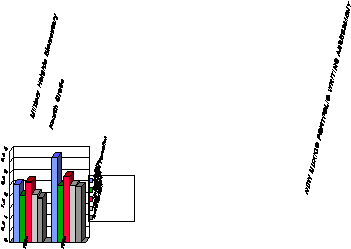
A primary objective for Military Heights and challenge for the Technology Project was to improve students' reading and writing processes. New Mexico requires all fourth grade and all sixth grade students to submit writing samples which are then evaluated by a three member committee. (The graph to the right depicts a comparison of 1994, 1995 and 1996 fourth grade writing process scores.)

The samples are rated in the areas of Holistic, Sentence Formation, Mechanics, Word Usage, and Development. Each is rated on a scale from one to three with three being the best. The holistic scale is one to six with six being the highest. The average holistic score for the state of New Mexico was a 2.25 for the fourth grade in 1995. As a direct result of the Technology Project, Military Heights had a 3.73 1995and 3.83 1996 average Holistic score for their fourth grade.
The next graph compares the fourth grade at Military Heights to average scores for 1995 from the school district as a whole and to averages from the state of New Mexico.
The staff believes that the IBM/Eduquest courseware "Writing to Write" was very instrumental in helping the students build writing skills. This courseware is available for kindergarten through the fifth grade. The continual academic success has proven that the full commitment model and outstanding software are on target in meeting student needs.
The next graph compares the sixth grade at Military heights to the state and district averages. The average holistic score for the state of New Mexico was a 3.0 for the sixth grade in 1995. The sixth graders at Military Heights scored an average holistic score of 2.78. However, the sixth graders at Military Heights did not benefit from the "Writing to Write" courseware since it is not available for the sixth grade. These students did not have the same opportunity as fifth graders to participate in technology enhanced learning in the writing area. As a result, sixth graders became our control group for the purpose of measuring the success of our Writing Process technology.
The sixth grade Writing Process scores have been compared for 1994 , 1995 and 1996 (in the graph to the right). The fourth grade class scores at Military Heights improved dramatically compared to the sixth grade control group after two semesters of exposure to computer technology and courseware. We believe that similar improvements were made by all participating classes. However 1996 scores show that the Full Commitment model and the W.T.W. software have made dramatic differences in student writing.
Test results also indicated student performance at or above previous levels in all other core areas of learning.
Other Measures of Success
Every year since the conception of this project parent surveys have been sent home with every student from Military Heights. Taking in account that that the majority of the famlies have more than one child here, the average return of the surveys run close to 70%. All returned surveys were favorable. Many parents wrote additional comments to express their overall support.
Student surveys were conducted at the school site by each classroom teacher. All students had positive responses. Many students expressed their preference for the use of computer technology instead of previous teaching methods as well as eagerness to continue to use technology because it was "fun".
Conclusion
We proved that multimedia technology combined with our Full Commitment Model has been abunduntly successful. We satisfied all the criteria by which the success of our pilot school was to be measured. Success has been demonstrated with improved test scores, increased levels of student motivation and a more effective and satisfied faculty.
Phelps Anderson, Director
John Bassett, Secretary/Director
Shirley Childress, Director
Rudy Cordero, Director
Eberhard Krebs, Director
Bruce Ritter, Treasurer/Director
Marlin Wells, Director
George Yates, President/Director
Doug Ylarraz, Director
Dr. Wayne Dotts, Advisor
________________
Foundation Executive Assistant
Diane Woodard
(505) 623-6601